Bottleneck measures the machine, ranks what is holding it back, and shows you what to change — with the reasoning in plain sight, so you can disagree with it.
Task Manager tells you what is busy right now. Benchmark suites give you a number with no opinion attached. Neither answers the only question that matters: of everything in this machine, which part is the one costing you time, and is replacing it worth the money?
Detects the hardware and runs short benchmarks on CPU, memory, disk and graphics. No install required — it will run from a USB stick.
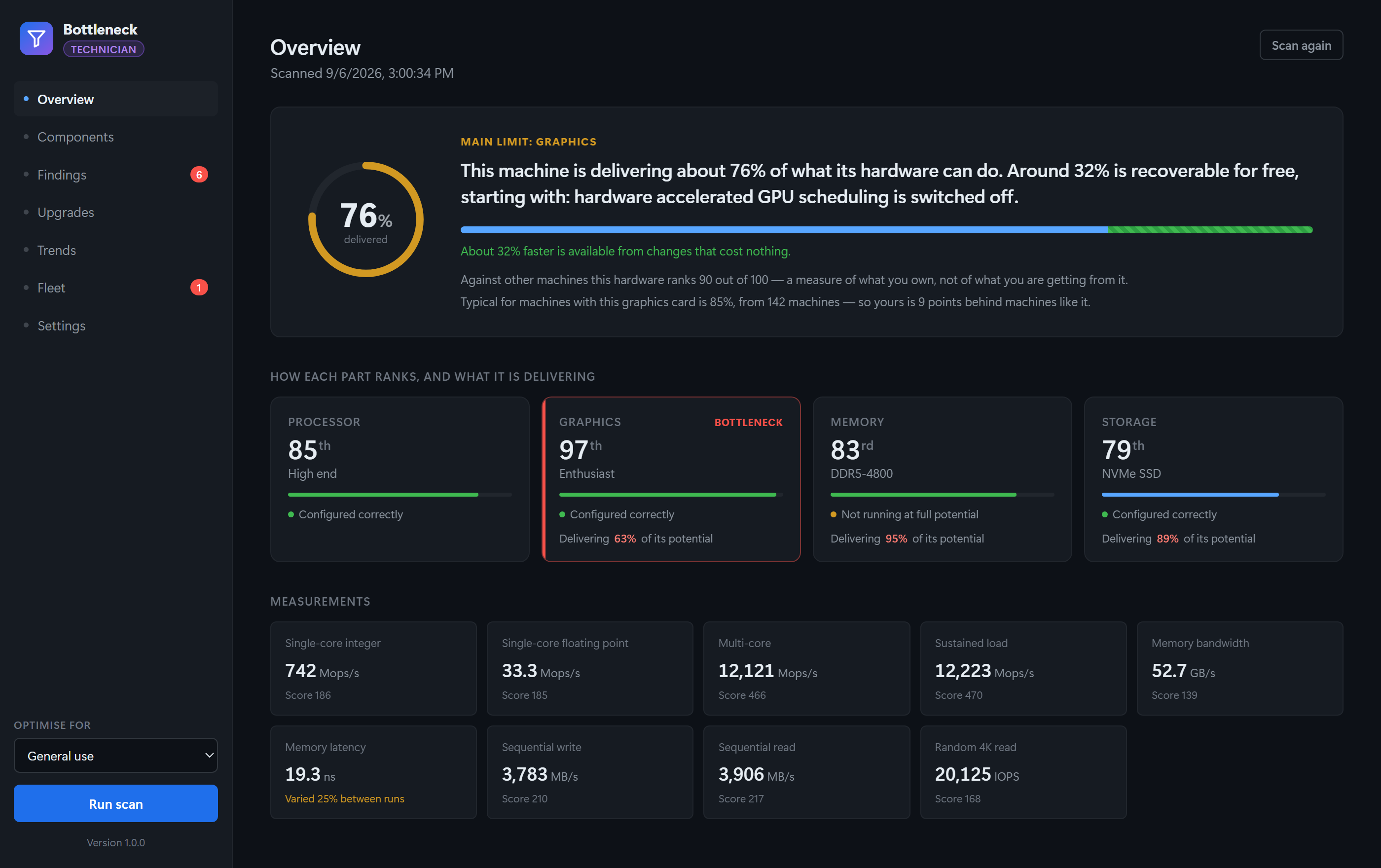
Scores each component against what current parts of its class actually achieve, using a reference dataset that updates as new hardware ships.
Sorts what it found by how much it is costing you, and shows the fix for each — settings first, hardware only where settings will not do it.
Every finding carries a severity and an explanation of what it is costing you, not a bare score.
Each finding says what to change and how. A restrictive power plan is a setting, not a purchase.
Where hardware genuinely is the limit, it says which part and what the change would buy you.
Scans are kept, so you can see a machine degrade rather than guess whether it used to be faster.
Export a printable HTML report readable by someone who has never seen the application.
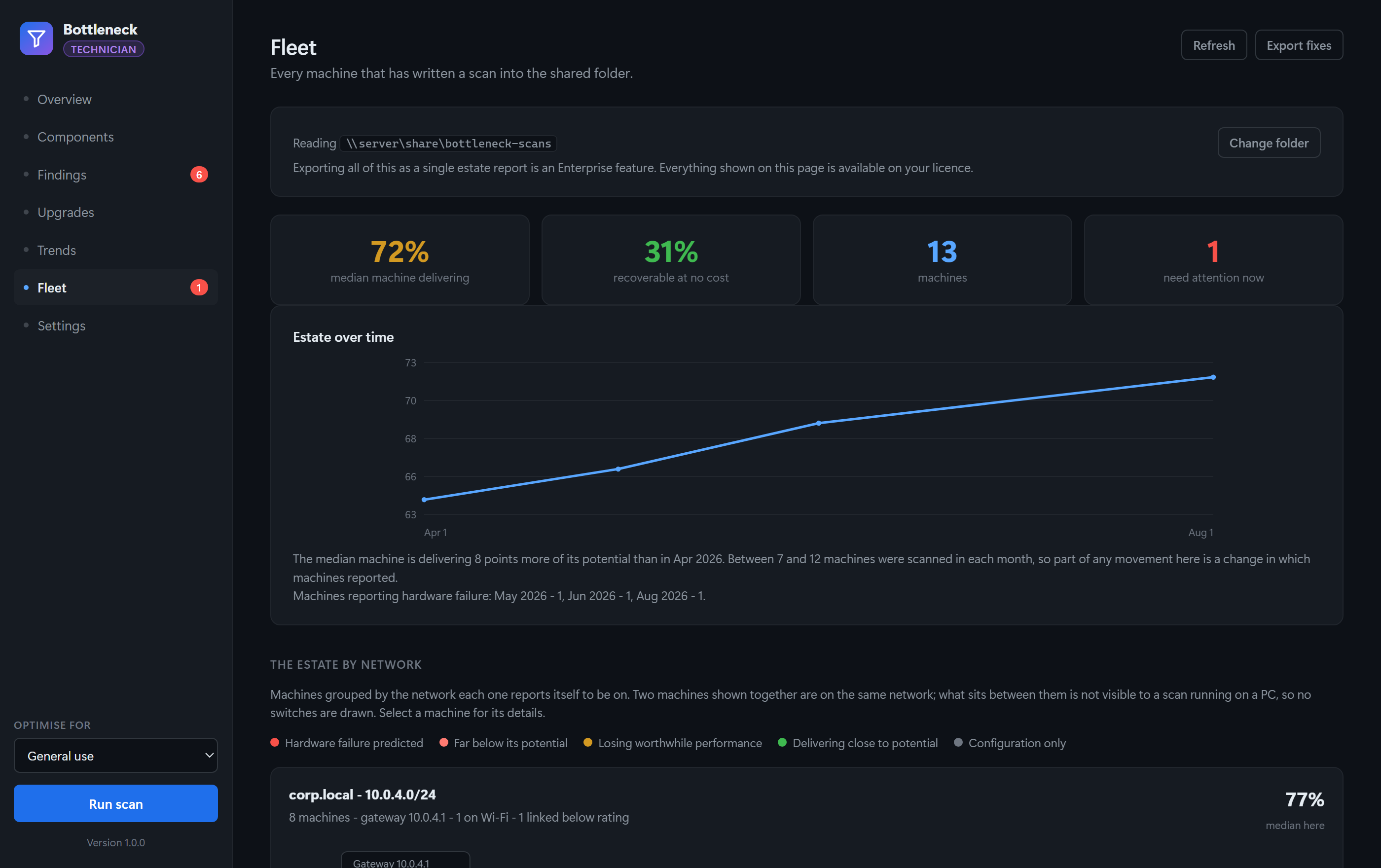
On Technician and above, every machine you have scanned side by side, with the estate’s trend.
There is no account, no telemetry, and no code path that transmits a scan. Results are written to your own disk and stay there.
A download of the reference dataset, carrying nothing about the machine — no hardware details, no results, no identifier. It can be switched off, and the application works identically without it.
That dataset drives purchase recommendations, so it is signed. Tampered data could push you toward buying things you do not need; a dataset that fails verification is discarded.
Your key is verified on your own machine against a public key compiled into the application. No activation server, so nothing to phone home to and nothing to go dark.
Licences are perpetual. The version you buy keeps working forever; only the entitlement to new versions lapses, after a year, and renewing it is optional.
A tool that overstates its certainty is worse than no tool, so here is where the edges are.
Expected scores come from published relative performance, anchored to measured hardware. For common parts this is close. For unusual configurations it is an estimate, and the application says so rather than presenting a confident number it cannot support.
Scans take minutes, not hours. That is the right trade for a diagnostic you will actually run, but it means Bottleneck measures sustained throughput less thoroughly than a dedicated stress-testing suite does.
Windows 10 and 11 on x64. There is no macOS or Linux build, and none is planned — most of what it does reads Windows-specific configuration.
An offline licence can prove a tier but never a count. Machine allowances are licence terms shown in Settings, not a lock. We would rather trust customers than add friction that punishes the honest ones.
The free tier scans, benchmarks and scores, with no time limit.